Stratagem Weekly
Stratagem for Your Future Market Battles
𝘛𝘦𝘯𝘵𝘩 𝘪𝘯 𝘢 𝘴𝘦𝘳𝘪𝘦𝘴: 𝘊𝘰𝘮𝘱𝘦𝘵𝘪𝘵𝘪𝘷𝘦 𝘈𝘥𝘷𝘢𝘯𝘵𝘢𝘨𝘦
In naming my firm 10 years ago, I specifically chose the word for “shrewd battlefield strategy.”
I recently spent three days studying an example of “stratagem” at a U.S. Civil War site, Gettysburg.
Constant scholarship on ”stratagem” informs the work I do advising businesses and brands around the world. The battles they’re trying to win are for market penetration, accelerated growth, increased margin, and competitive advantage. I’m always researching what used to work, what’s changed, and what data and case-based evidence arguments can provide future advantage. (If you’ve missed findings from my studies, you can go to my LinkedIn posts on acceleration and alignment.)
What’s your stratagem to win market battles of the future?
When working with organizations, my first step is always to research and frame THE essential challenge that must be overcome to achieve the organization’s ambitions, mission, and future viability. This includes an “audit” of the current situation, value proposition, and competitive strategy. My second step? Insights from analyzing competitor stratagem, customers’ unmet needs, and foresight on the marketplace of the future — including changes leading to one’s future competitive set.
From this, the work turns to casting a winning stratagem. Such a strategy is referred to as “elegant” because on the surface it looks so simple, and yet, it addresses several issues in one fell swoop.
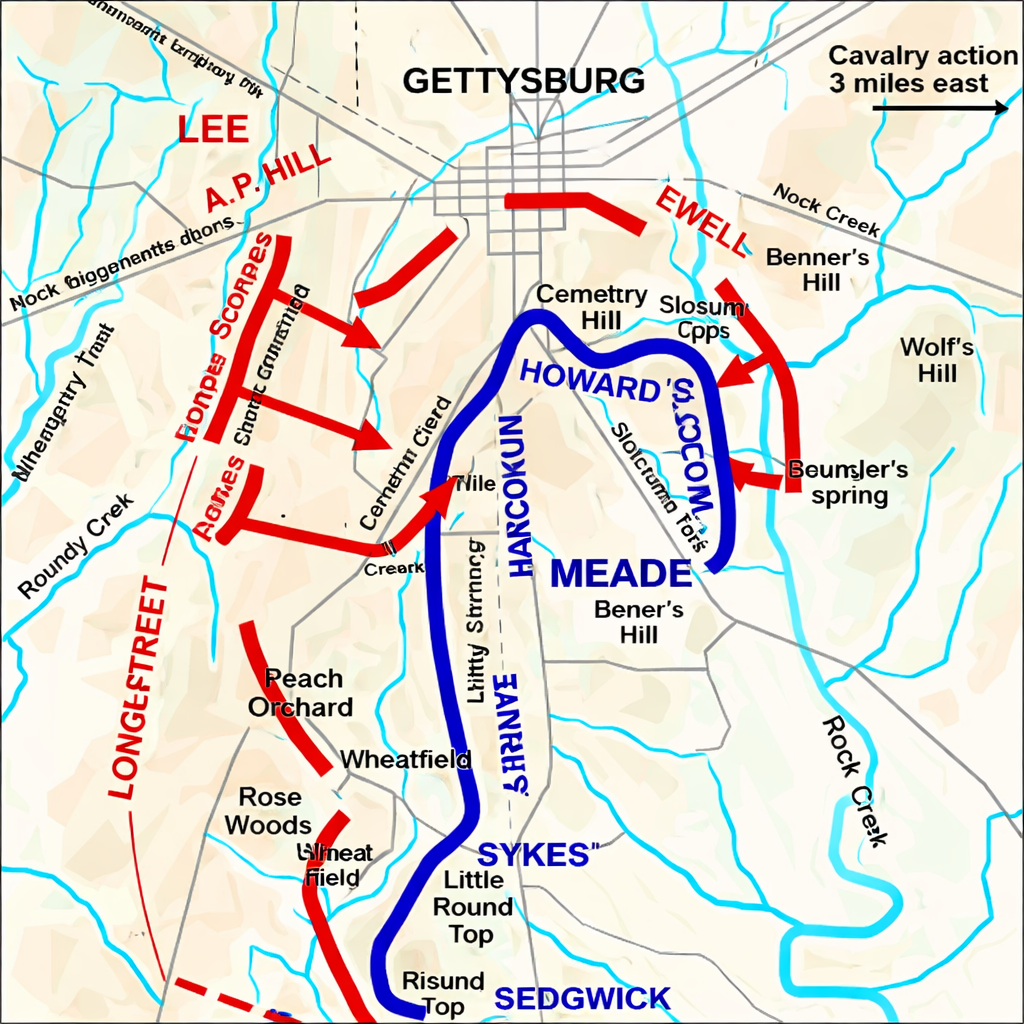
When studying the 1863 rise and fall of both sides at Gettysburg, I was struck by the winning stratagem used by the Union’s Gen. Meade to defeat the Confederacy’s Gen. Lee.
Lee came to the three-day battle having prevailed in many prior arenas. His troops had fought aggressively on days one and two. On day three, he arrayed them in an intimidating seven-mile line across the front.
The essential challenge Meade faced was how to win decisively against seemingly impossible odds.
His stratagem? Singular and elegant: Position Union troops on the high ground in the shape of a fishhook. In one fell swoop, this enabled his army — positioned inside the fishhook — to shift troops quickly from one threatened point to another, since assaults on the flanks were only a sprint away. In contrast, Lee was forced into costly frontal and flank assaults that increased exposure and required his troops to travel farther to reinforce losses.
As is said of Gettysburg, “the rest is history.” Yet the imperative for every leader to have a clear, easy-to-articulate strategy for how their organization can win is just as true today as it was 163 years ago.
What’s your stratagem to win market battles of the future? May it be so remarkable that, like Meade’s, it is studied for decades to come.
To read more about services at Lindsay Foresight and Stratagem, visit our Workshop, Speeches and Trainings page and see my most recent Linkedin Post.